
10:50 p.m.
Iwan,
Thank you for this information.
I appreciate the distribution of funding opportunities for advancing our research
faculty.
Rosalind
Rosalind Horowitz, Ph.D.
Professor, International Discourse and Literacy Studies,
Culture, and Learning Sciences
The University of Texas at San Antonio
UTSA Member, Alliance of Hispanic Serving Research Universities, (HSRU)
Launched June 2022
“As my father planted before me, so I plant for future generations.”
The Talmud
Ambassador, Tier I Research, UTSA
Former Member, Research Advisory Board to the President
Historian 2022-2023, American Educational Research Association,
Special Interest Group (SIG) Research in Reading and Literacy
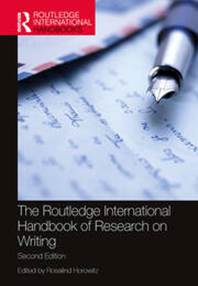
[Text Description automatically generated]The Routledge International Handbook of
Research on Writing inaugurates a wide scope of international research advancement, with
attention to writing at all levels of schooling and in all life situations. It provides
advanced surveys of scholarship on the histories of world and child writing and literacy;
interconnections between writing, reading, and speech; digital writing; writing in
communities; writing in the sciences and engineering; writing instruction and assessment;
and writing and disability. A section on international measures for assessment of writing
is a new addition to this compendium of research.
Rosalind Horowitz Editor, The Routledge International Handbook of
Research on Writing
ISBN 9781138345256
Published February 2023 by Routledge/Taylor & Francis
630 Pages 93 B/W Illustrations
The Routledge International Handbook of Research on Writing (Routledge Handbooks in
Communication
Studies)<https://www.amazon.com/Routledge-International-Handbook-Handb...
(Click on Blue Link to reach Amazon for all publications)
[cid:image003.jpg@01D98367.D6E767A0]
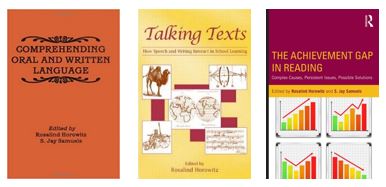
Co-Editor, Comprehending oral and written language (Academic Press and
Brill, United Kingdom)
Comprehending Oral and Written
Language<https://www.amazon.com/Comprehending-Oral-Written-Language-Sa...
Editor,Talking Texts: How speech and writing interact
in school learning (Routledge/Taylor & Francis Group)
Talking
Texts<https://www.routledge.com/Talking-Texts-How-Speech-and-Writing-I...
Co-Editor,The Achievement Gap in Reading: Complex causes,
persistent issues, possible solutions (Routledge/Taylor & Francis)
The Achievement Gap in
Reading<https://www.routledge.com/The-Achievement-Gap-in-Reading-Compl...
College of Education and Human Development
Joint Appointment, Departments of Interdisciplinary Learning
and Teaching; and Educational Psychology
The University of Texas--San Antonio
One UTSA Circle
San Antonio, Texas 78249-0654
United States of America
Distinguished Alumni, University of Minnesota--Twin Cities
Inspiring Minds for a Century, 1905-2005
Excellence in Globalism Advancement, Selected by the College of Education
of Human Development, UTSA
National Academy of Education, Spencer Fellow
Editorial Boards: Reading Research Quarterly; Written Communication, JLR. Journal of
Literacy Research;
Diaspora, Indigenous, and Minority Education. Studies of Migration, Integration, Equity
and Cultural Survival
(C) 210-860-1305
Office: Main Building 2.310
6900 North Loop 1604 West
San Antonio, Texas 78249-0654
Rosalind.Horowitz@utsa.edu<mailto:Rosalind.Horowitz@utsa.edu>
[cid:image004.png@01D98367.D6E767A0]
From: Iwan Notowidigdo <iwan.notowidigdo(a)utsa.edu>
Sent: Wednesday, May 10, 2023 4:59 PM
To: COEHD(a)lists.it.utsa.edu
Cc: Emily Bonner <Emily.Bonner(a)utsa.edu>; Daniel Riechers
<daniel.riechers(a)utsa.edu>; Research Service Center for Arts-Business-Education
<RSC-ABE(a)utsa.edu>
Subject: [Coehd] Funding Opportunity: Dear Colleague Letter on Artificial Intelligence in
K-12 Ed
Greetings Colleagues,
Many of you are exploring research into artificial intelligence and its implications for
education. NSF has released a Dear Colleague Letter informing us about funding on AI in
classrooms and out-of-school settings. The application mechanism is the RAPID grants,
which I pasted below the section from the page II-43 of the NSF Proposal and Award Policy
and Procedures Guide (as cited in the DCL).
NSF 23-097
Dear Colleague Letter: Rapidly Accelerating Research on Artificial Intelligence in K-12
Education in Formal and Informal Settings
Directorate for STEM Education (EDU)
May 8, 2023
Dear Colleagues:
The unprecedented speed of advancements in machine learning (ML), generative artificial
intelligence (AI), and large language models (LLM) is rapidly transforming formal and
informal educational settings and systems. Educators and learners are grappling with
unanticipated and rapidly changing AI that impacts both day-to-day K-12 classroom
practices and the use of AI in informal (out of school) settings.
In response to these technological changes, the nature of learning, teaching, and
assessment is rapidly evolving. Schools are faced with insufficient research-based
findings on the use of AI tools and environments for teaching; other educational
organizations are equally challenged. There is also a great need to clarify which AI
concepts and principles K-12 students should be learning. Finally, it is critical to
investigate the ways AI will both promote and impact equitable education and inclusive
learning.
As a result, there is a severe urgent need for research on the use of AI, and the teaching
of AI, in K-12 classroom and informal settings. This Dear Colleague Letter (DCL) invites
researchers to submit Rapid Response Research (RAPID) proposals for time-sensitive
research including, but not limited to:
* Developing AI tools and environments to advance age-appropriate equitable learning
and inclusive teaching;
* Supporting learning about and interest in AI;
* Using AI to teach AI; and,
* Integrating generative AI in education in an ethical, responsible, and effective
way.
Proposed projects must include strong data-driven research methods in need of a quick
response due to rapidly changing AI. NSF strongly encourages proposals that will sustain
and advance diversity, equity, and inclusion in STEM education research. Likewise, NSF is
seeking proposals that will have an impact on underserved and underrepresented schools and
communities.
Requests for RAPID proposals may be for up to $200K and up to one year in duration.
PREPARATION AND SUBMISSION INSTRUCTIONS
Proposers must submit a 1-page Concept Outline that details the proposed research by email
to RAPID-DRL-AI@nsf.gov<mailto:RAPID-DRL-AI@nsf.gov>.
The prospective PI will receive an email from the cognizant NSF program officer specifying
whether a full proposal may be submitted. The email confirming approval to submit a RAPID
proposal must be uploaded by the prospective PI in the “Program Officer Concurrence Email”
section of Research.gov.
Guidance on submitting a RAPID proposal may be found in Chapter II.F.2 of the NSF Proposal
& Award Policies & Procedures
Guide<https://www.nsf.gov/publications/pub_summ.jsp?ods_key=pappg> (PAPPG).
In addition, the following instructions apply:
* Either an IRB approval or approved exemption is required. The IRB approval date or
exemption number should be provided on the proposal Cover Sheet.
* Proposals must specify plans for bounding the proposed research within reasonable
constraints given rapidly changing technology.
Invited proposals must be submitted via Research.gov to the current PAPPG and directed to
the EDU/DRL “ITEST - Innovative Technology Experiences for Students and Teachers”.
Proposal titles should begin with the phrase, "DRL AI:" after the prepended text
“RAPID:”.
After the submission of the RAPID proposal, PIs should alert the cognizant program
officers by sending an email to RAPID-DRL-AI@nsf.gov<mailto:RAPID-DRL-AI@nsf.gov>
with the proposal number assigned to the submission. Proposals submitted in response to
this DCL will be subject to internal NSF review only.
Proposals submitted to this DCL will be reviewed and funded on a rolling basis while this
notice is posted.
DISSEMINATION
Briefing Paper and Presentation at NSF forum
Each project must post a briefing paper on a public project website, 12-months post-award.
The briefing paper should inform a broad audience about (a) research results; and (b) how
the results inform future research and practice in the short- and long-term.
The PI also must present results at an NSF forum that will be held virtually approximately
one-year post-award.
POINTS OF CONTACT
All correspondence should be directed to
RAPID-DRL-AI@nsf.gov<mailto:RAPID-DRL-AI@nsf.gov>.
DUE DATE
Required Concept Outlines may be submitted at any time.
Sincerely,
James L. Moore III, Assistant Director
Directorate for STEM Education
Here are the instructions for submitting a RAPID grant proposal application.
2. Rapid Response Research (RAPID) Proposal
RAPID is a type of proposal used when there is a severe urgency with regard to
availability of or access to, data, facilities or specialized equipment, including
quick-response research on natural or anthropogenic events and similar unanticipated
occurrences.
RAPID proposals are NOT for:
• projects that are appropriate for submission as "regular" NSF proposals;
• events that are unanticipated due to lack of awareness of timelines; or
• collection of only non-perishable data.
PIs are advised that they must submit a concept outline prior to submission of a RAPID
proposal. This will aid in determining the appropriateness of the work for consideration
under this type of proposal. Concept outlines can be submitted either by email to a
cognizant Program Officer or via ProSPCT. An NSF funding opportunity that includes RAPID
proposals will provide specific guidance on submission of concept outlines using either
email or via ProSPCT. See Chapter I.D.1 for additional information on concept outlines.
For concept outlines that must be submitted via ProSPCT, users must have a valid Login.gov
account to access the tool. The prospective PI will receive an email from the cognizant
NSF program officer that specifies whether a full proposal may be submitted. The email
confirming approval to submit a RAPID proposal must be uploaded by the prospective PI in
the “Program Officer Concurrence Email” section of Research.gov. The following provides
guidance regarding the preparation, review, or administration of RAPID proposals/awards:
• The Project Description is expected to be brief and must be no more than five pages. It
must include clear statements as to why the proposed research is urgent and why RAPID is
the most appropriate type of proposal for supporting the proposed work. Note this proposal
preparation instruction deviates from the standard proposal preparation instructions
contained in this Guide; RAPID proposals must otherwise be compliant with the proposal
preparation requirements specified in Part I of the PAPPG.
• The “RAPID” proposal type must be selected in the proposal preparation module in
Research.gov.
• The project title will be preceded by the prefix “RAPID:” Only internal merit review
is required for RAPID proposals. In some instances, Program Officers may elect to obtain
external reviews to inform their decision. If external review is to be obtained, then the
PI will be informed in the interest of maintaining the transparency of the review and
recommendation process.
• Email documentation from at least one NSF Program Officer confirming approval to submit
a RAPID proposal must be uploaded by the PI as a document entitled “RAPID – Program
Officer Concurrence Email” in the Supplementary Documentation section of Research.gov.
• Requests may be for up to $200K (including indirect costs) and up to one year in
duration. The award size, however, will be consistent with the project scope and of a size
comparable to grants in similar areas.
• RAPID proposals are not eligible for reconsideration, if declined. See Chapter
IV.D.2.b.
• No-cost extensions and requests for supplemental funding will be processed in accordance
with standard NSF policies and procedures.
• Renewed funding of RAPID awards may be requested only through submission of a
Traditional or Accomplishment-Based Renewal proposal that will be subject to full external
merit review. See Chapter V for further information.
[the source document for the above instructions is
https://nsf-gov-resources.nsf.gov/2022-10/nsf23_1.pdf]
Please contact me for support if you are interested in applying.
Thank you.
--Iwan
Mr. Iwan Notowidigdo
Senior Grant Development Manager
The University of Texas at San Antonio
College of Education & Human Development (COEHD)
iwan.notowidigdo@utsa.edu<mailto:iwan.notowidigdo@utsa.edu>
(Mobile: 347-231-5931)
Regular Office Hours NEW
Mondays at 3 PM CST
No advanced registration necessary
https://utsa.zoom.us/j/92065601904
or schedule an appointment with me through Calendly
https://calendly.com/iwan-notowidigdo/30min
[cid:image005.png@01D98367.D6E767A0]



1258
days inactive
1258
days old
0 comments
1 participants
participants (1)
-
 Rosalind Horowitz